The problem nobody likes admitting
Here's the thing about voice bots: they're really good at sounding sure of themselves even when they have no idea what just happened. Speech-to-text spits out a transcript, hands it to a language model, and the model confidently decides what to do next. The catch is that "confidence" is usually just fluent-sounding text. There's no real number behind it. Research on this is fairly consistent: when LLMs put their confidence into words, they tend to be overconfident (Xiong et al., ICLR 2024).
And it's not only names. It's a misheard amount, a swallowed "not," a yes that came out sounding like a no, a date that got clipped mid-word. Any of these can slip past the model unflagged, and the pipeline just keeps going and takes an action on the wrong information.
That's a mild annoyance in a text chatbot, where a typo just sits there until someone rereads it. In a voice system it's a genuine problem, because the model rarely gets a second look at the raw audio, and one bad guess anywhere in the sentence sends the whole conversation, and whatever action it triggers, down the wrong road.
One word goes sideways, the whole action follows
Say someone calls a bank's voice line to move money. He says his name is Alex and to send five thousand rupees. Speech-to-text mishears Alex as "Ah, Lex," splitting it into two syllables that sound like nothing in particular. Or it hears the amount as fifty thousand instead of five thousand. Or the customer says "don't send it yet" and the "don't" gets clipped and disappears entirely. Any one of these is a single wrong word buried in an otherwise clean transcript.
A typical cascading setup just barrels ahead with whatever transcript it got. The language model reads the sentence, doesn't flag anything as unusual, and either proceeds with the wrong amount, sends money nobody asked to send, guesses the closest name in the system, or can't match the account and falls back to a generic "can you repeat that?" without knowing whether the real problem is the name, the amount, or something else entirely. It's making a decision, but it's making it blind, because nothing in the pipeline actually measured how sure anyone should be about any single piece of that sentence before acting on it.
This is exactly the kind of moment where a few honest probability numbers, read straight off the model instead of guessed at in generated text, would change the outcome. Instead of one big "what do I do," you'd want several small, specific questions asked at once: does the name in this transcript match the account holder on file, is the amount unambiguous, does the sentence contain a negation that might have been clipped, should this go to a human?
Doesn't the STT already give a confidence score?
It does. Most providers return one per word and per utterance; Deepgram's responses, for example, carry a confidence between 0 and 1 on each word and each utterance (docs). It's a useful signal, but it answers a narrower question than the one we care about. It tells you how sure the recognizer was about the sounds, not whether "fifty thousand" makes sense on this call. A word that got dropped entirely, like the clipped "don't," has no score at all, because it isn't in the transcript. And in a 2025 study of ASR confidence scores, Kuhn et al. found that they correlate with accuracy but their error detection performance is limited: classifiers built on them frequently missed errors or raised many false alarms.
There's also the word "honest" doing a lot of work here. A number is only useful if it's calibrated, meaning that among all the times the system says 0.9, it's right about 90% of the time. Guo et al. (2017) showed that modern neural networks are often poorly calibrated out of the box, and that a simple post-hoc fix, temperature scaling, helps a lot. Calibration doesn't come for free, it has to be trained or fitted for.
Enter Jev, and a trick you've already seen
Jev is a model from a startup called TypeSafe AI, released on September 16, 2026, and it's built around producing exactly this kind of number. TypeSafe calls it a "System One" model: instead of generating text, it returns typed decisions with probabilities, and it's trained with what they call Reinforcement Learning for Calibrated Decisions (RLCD) (announcement). Quick disclaimer: I haven't built anything on Jev yet, and it's in early access behind a waitlist, so take the rest of this as my read of how it's described to work, not a tested claim.
The interface is what makes it interesting. You hand it your context once, plus a set of typed questions, and there are three kinds (MarkTechPost, LangChain):
- Choice: pick from a set of options (up to 255). You get a probability for each option and an overall confidence score.
- Score: rate the input against ordered levels like low, medium and high. You get a score, the distribution behind it, and a confidence value.
- Noul: a yes-or-no question (the odd name is TypeSafe's). You get one number from 0 to 1, the probability that the answer is yes.
The questions run in parallel and in isolation against the same shared context, so adding another question barely changes the response time. No "I think it's 90% likely" typed out in a sentence, just a number that's supposed to mean what it says.
If you've worked with Whisper, the shape of this isn't new. Whisper's language detection doesn't write "I think this is Hindi" as a sentence. It reads the probabilities the model assigns to its language tokens and picks the highest, no free-form text generation involved (paper, code). Jev generalizes the idea: instead of one hardcoded question about language, you define whatever question you want on the spot, and you still get a number back, not a guess dressed up in words. One caveat on the analogy: TypeSafe hasn't published Jev's architecture, so I'm comparing the idea, not the internals.
So, can Jev actually help here?
Back to the call. Here's how I picture this playing out, purely as an idea, not something I've run myself. Instead of sending the shaky transcript to one model and hoping it both figures out the intent and honestly reports how unsure it is, you'd hand that transcript to Jev once as shared context, then ask a handful of small, independent questions about the specific risky pieces:
- Name match (Noul): the bank already knows which account this call is for, from the caller's number or the session. So the question is simply: is the name the caller just said the same person as the account holder on file, "Alex Miller"? A yes/no with a probability.
- Amount (Noul): is the amount unambiguous, or could a digit have been misheard?
- Negation (Noul): does the sentence contain a negation, like "don't," that might have been clipped?
- Handoff (Noul or Score): should this call go to a human instead of continuing automatically?
Each of those would come back as an actual number, not a sentence, at least based on how it's described. Now you could set real thresholds per sub-task instead of one blanket confidence. If the name-match question comes back at 0.94 but the amount question comes back at 0.5, you don't just proceed, you specifically re-confirm the amount and nothing else. If the negation check comes back high, you stop before taking an irreversible action, instead of quietly assuming the sentence meant what it sounded like. TypeSafe's own examples lean the same way: confidence-based model routing, and "risk gating," where a Jev check blocks a risky tool call before it executes. The system wouldn't be smarter about audio, it would just finally be honest, sub-task by sub-task, about what it doesn't know.
The flow, drawn out
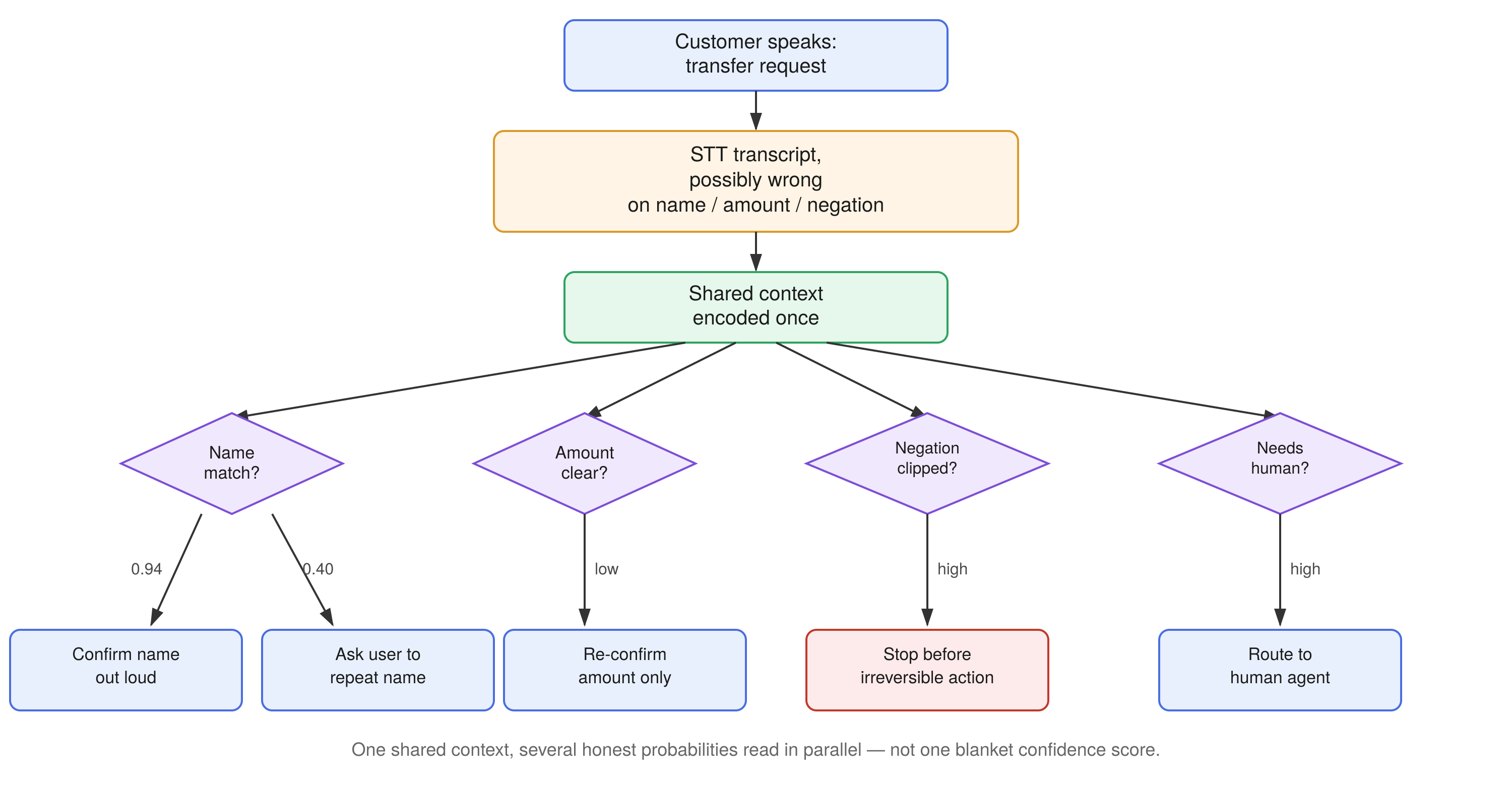
One transcript in, several honest probabilities out, each about a different risky piece of the sentence, all read at once instead of one blanket "confidence" guess.
What I'd check before trusting it
Since I haven't run it, this is the list I'd work through first:
- Latency. TypeSafe quotes 70 to 500 ms end to end. In a voice pipeline that's a real slice of the turn budget, so I'd only call it on turns that matter (anything that moves money or changes an account), not on every utterance.
- The numbers are self-reported. The speed, cost ($0.042 per million input tokens, output free) and accuracy claims all come from TypeSafe's own evals, and their announcement says as much about possible bias.
- "Zero hallucinations" is not "always right." It means the output always matches the schema you defined. TypeSafe says plainly that the 0% figure isn't empirical and answers can still be wrong. The value is in the calibration, so I'd measure it on real call transcripts.
- My domain is not their demo domain. Names, code-mixed speech and accents are where STT mistakes cluster for me, and I haven't seen anything showing how well the probabilities hold up there. I'd check calibration on my own data before setting thresholds.
- Hosted only. It's an API in early access, with no self-hosting option and no published weights. For calls involving financial details, that's a data-handling question to settle up front.
The takeaway
Voice AI doesn't need a smarter-sounding model, it needs a more honest one about which parts of a sentence it's actually unsure of. The failures that matter in real calls are rarely the whole sentence being wrong, they're one word, a name, an amount, a "not," slipping through unflagged and triggering the wrong action. Whether Jev is the thing that fixes this, I genuinely don't know yet, I haven't built with it. But the shape of the idea, ask small specific questions and get real numbers back instead of one confident-sounding answer, is similar in spirit to language ID in Whisper, just applied to every risky piece of a sentence instead of just one.
References
- TypeSafe AI, Introducing System One Models & Jev
- MarkTechPost, TypeSafe AI Releases Jev
- LangChain, What Is Jev? A Guide to TypeSafe AI's System One Model
- Radford et al., Robust Speech Recognition via Large-Scale Weak Supervision (Whisper) and the openai/whisper repo
- Guo et al., On Calibration of Modern Neural Networks (2017)
- Xiong et al., Can LLMs Express Their Uncertainty? An Empirical Evaluation of Confidence Elicitation in LLMs (ICLR 2024)
- Kuhn et al., Evaluating ASR Confidence Scores for Automated Error Detection in User-Assisted Correction Interfaces (2025)
- Deepgram docs, Utterances (per-word and per-utterance confidence fields)